Commercial Metal Roofing Columbus, OH
Commercial metal roofing Columbus businesses and property owners are choosing as a permanent fix — not another 15-year membrane cycle — is the decision this page is designed to help you make with full information.
We are a Columbus metal roofing contractor serving Franklin County and the surrounding metro since 2012, specializing exclusively in Columbus commercial metal roofing for warehouses, office buildings, retail centers, manufacturing plants, medical facilities, and more.
Every project is executed by using commercial-grade systems specified for Central Ohio’s climate — freeze-thaw cycling, spring hail, summer derechos, and the humidity that shortens membrane life faster than most property owners expect.
Call to Get Your Free Commercial Metal Roof Quote!
Why Choose Commercial Metal Roofing Columbus, OH?
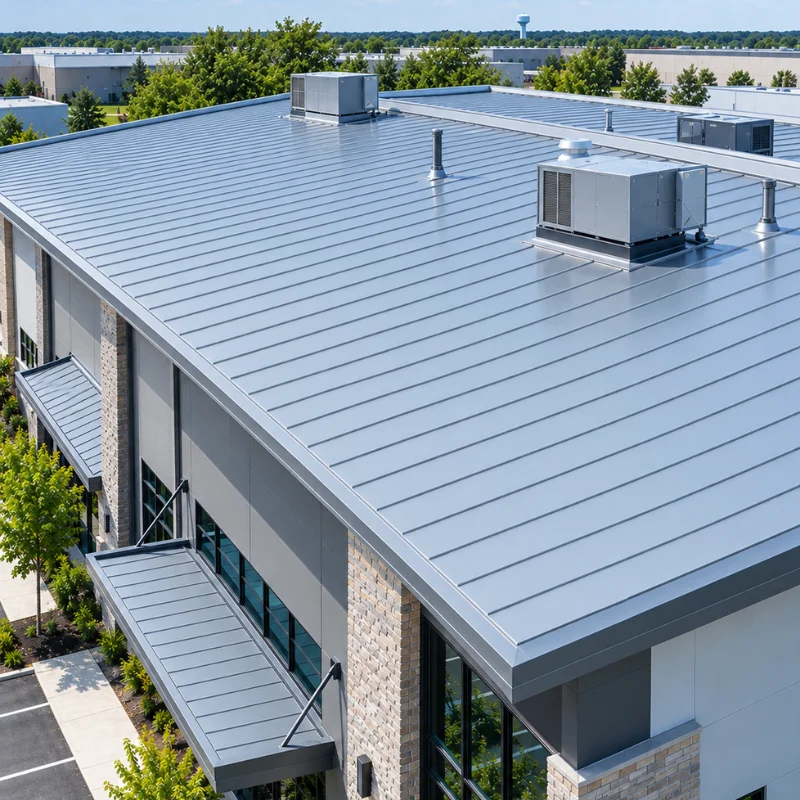
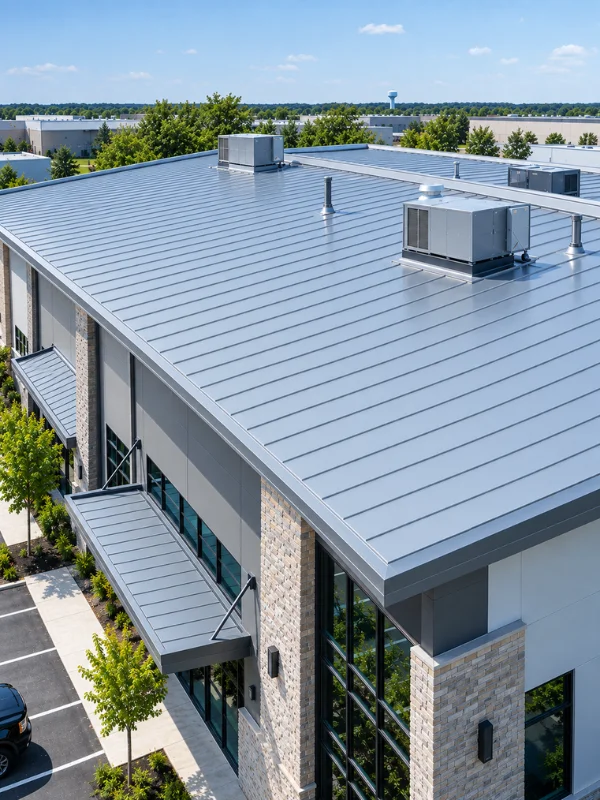
A Columbus commercial roof takes hits from every direction — hail in spring, derechos in summer, and 50-plus freeze-thaw cycles every winter. Commercial metal roofing Columbus businesses trust handles Ohio’s hail season, hard winters, and humid summers without the maintenance schedule that flat roof systems demand from day one.
Metal Roofing vs. Other Commercial Roof Systems
The 50-year math is clear. Metal costs more in year one and wins decisively at year 25 and beyond.
Metal vs. TPO & EPDM Flat Roof Membranes
TPO is the default commercial membrane in Columbus — heat-weldable, white-surfaced, competitively priced at installation. But Ohio’s freeze-thaw cycling and summer surface temperatures exceeding 160°F progressively weaken seam integrity, pushing realistic TPO lifespans to 15 to 22 years.
EPDM tape-bonded laps lose adhesion over time, and dark ballasted EPDM absorbs solar heat rather than reflecting it. Metal outperforms both on lifespan, foot-traffic resistance, and long-term maintenance requirements. For Columbus commercial buildings where slope can be established — new construction, reroofs with subframing, or retrofit systems — metal is the superior specification for any property with a 15-plus-year hold horizon.
Metal vs. Modified Bitumen & Built-Up Roofing
Modified bitumen is the roofing legacy on most of Columbus’s older industrial and warehouse inventory — particularly the Rickenbacker corridor and south Columbus manufacturing district. It lasts 20 to 30 years with proper maintenance and periodic recoating. Built-up roofing (BUR) on 1960s-to-1970s commercial buildings can reach 30 to 40 years but is heavy at 12 to 25 pounds per square foot and expensive to remove.
Metal retrofit systems — standing seam over structural sub framing installed above the existing surface — are increasingly the preferred replacement path for both systems, eliminating tear-off cost and business disruption simultaneously.
Long-Term ROI: Metal vs. Membrane Over 50 Years
The 50-year math is clear. Metal costs more in year one and wins decisively at year 25 and beyond.
Below are 2024-dollar estimates without inflation adjustment. The directional conclusion is consistent: metal’s higher installation cost is offset by eliminated replacement cycles and near-zero maintenance spend over 50 years.
System | 50-Year Todal Cost |
|---|---|
TPO (2 replacements + maintenance) | $220,000 – $380,000 |
EPDM (2 replacements + maintenance) | $210,000 – $355,000 |
Standing Seam Metal (1 install + minimal maintenance) | $148,000 – $300,000 |
Types of Commercial Metal Roofing Systems
Every roof we install is matched to your building’s architecture, your requirements, and your long-term performance goals.
Standing Seam (Concealed Fasteners)
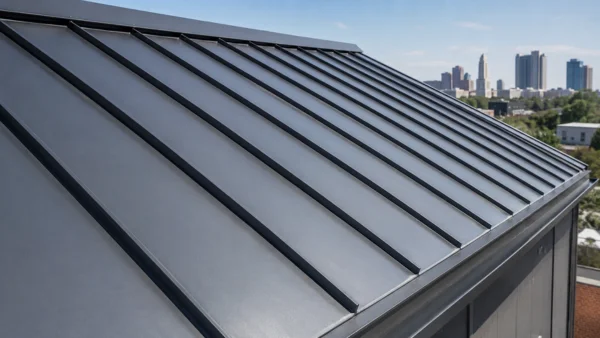
The highest-performing commercial metal system available. Panels interlock at raised vertical seams with attachment clips hidden inside — no exposed fasteners penetrating the panel face, which is the primary failure point of every other metal roofing category. Floating clip attachment accommodates thermal expansion on long commercial panel runs without stressing the seam or the structure.
Available in 24-gauge and 22-gauge steel and aluminum substrates. Correct specification for Columbus commercial buildings where 50-plus-year performance and minimal maintenance are the primary objectives.
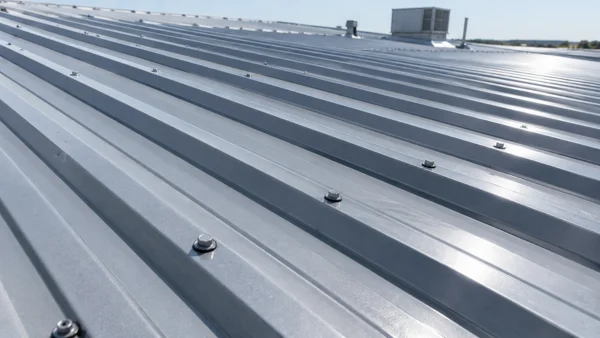
Exposed-Fastener / R-Panel & Corrugated Systems
R-panel and corrugated exposed-fastener systems cost less than standing seam and install faster. They’re appropriate for Columbus commercial applications where budget is the primary constraint and the building doesn’t justify the standing seam premium: secondary warehouses, agricultural structures, covered loading areas, and equipment storage buildings.
26-gauge minimum for primary commercial applications. Fastener washer inspection every 10 to 15 years is the main maintenance requirement. Realistic service life: 30 to 40 years with proper maintenance.
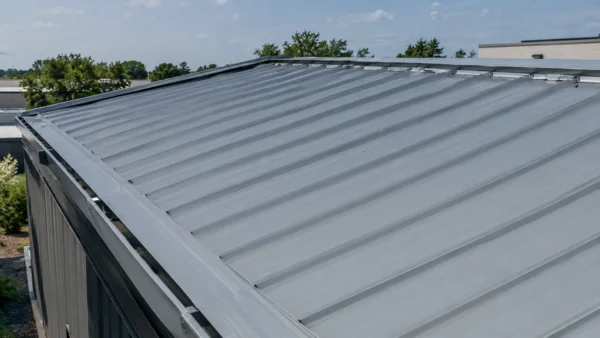
Metal Retrofit & Roof-Over Systems (No Tear-Off Required)
A retrofit system installs a new metal roof over an existing flat membrane using structural sub framing attached through the existing system to the deck below. No tear-off, no disposal cost ($3 to $6 per square foot eliminated on commercial scale), and zero business disruption during removal.
The sub framing establishes slope on previously flat sections, improving drainage and eliminating the ponding water problems common on aging Columbus flat roofs. Qualification requirements: dry existing insulation confirmed by core sampling and adequate deck structural capacity for sub framing loads — both verified before any scope discussion.
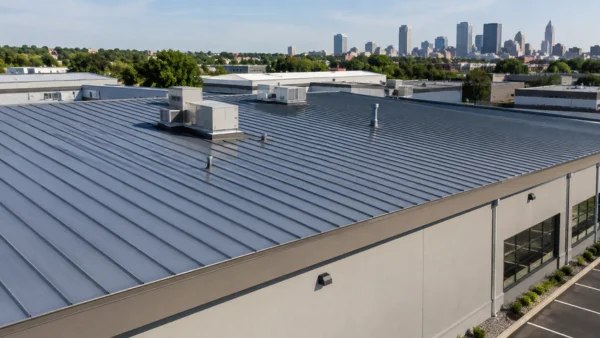
Low-Slope Commercial Metal Roofing Columbus
Modern mechanically-seamed standing seam can be installed on slopes as low as 1/2:12, which covers most of Columbus’s commercial building stock, designed for flat or low-slope membrane systems.
At these slopes, a continuous sealant bead through the seam joint and verified seam lock depth from a calibrated electric seamer are mandatory. This is precision work that requires specific training and calibrated equipment — not a scope for general roofing crews that install metal occasionally.
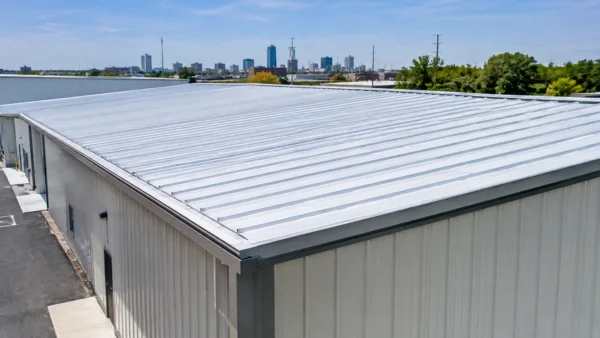
Insulated Metal Panels
IMP systems — factory-laminated metal skin and rigid foam core — achieve R-20 to R-26 in a single-component assembly that replaces deck, insulation board, and membrane in one installation step.
For refrigerated distribution facilities in the Rickenbacker corridor, cold-storage warehouses, pharmaceutical plants, and data centers in the Columbus metro, the thermal performance advantage over conventional built-up assemblies is significant. Labor savings from reduced field assembly steps narrow the cost gap considerably on large-format Columbus commercial projects.
Metal Roofing Materials, Gauges & Coatings
We prepare a detailed proposal specifying every component: panel manufacturer, product line, gauge, coating, color, underlayment, flashing material, fastener type, and snow guard layout if applicable.
Heavy-Gauge Steel: 22-Gauge & 24-Gauge Commercial
24-gauge is the standard for most Columbus commercial standing seam applications — sufficient structural capacity for standard purlin spacing, consistent with Class 4 UL 2218 impact rating, and the rigidity required to hold flat section appearance across large roof areas without oil-canning.
22-gauge is specified for wide-span systems (6 feet on center or greater), high-wind exposure buildings in exposed Delaware County hilltop positions, or concentrated rooftop equipment loads. 29-gauge has no place on primary commercial roofing — it belongs on pole barns.
Galvalume vs. Galvanized Steel for Commercial Builds
Galvalume (55% aluminum / 43% zinc alloy) outperforms G-90 galvanized steel on long-term corrosion resistance in Central Ohio’s humid, high-precipitation climate. The aluminum fraction provides sustained barrier protection at the substrate surface; the zinc fraction provides sacrificial protection at cut edges. Products meeting ASTM A792 carry a 25-year substrate warranty against corrosion perforation.
We specify Galvalume as the default substrate on all Columbus commercial metal roofing standing seam projects. G-90 is appropriate on complete paint systems — metal shingle and architectural profiles — where the full coating covers all substrate surfaces.
Kynar 500 / PVDF & ENERGY STAR Cool Roof Finishes
Kynar 500 is the industry benchmark for commercial metal paint performance. The PVDF resin coating is factory-baked onto the panel at temperatures that produce a molecular bond — not a paint-over-primer adhesion. 40-year paint warranties covering chalking and fading are standard on Kynar 500 products. SMP coatings on lower-cost commercial metal products show visible chalking within 15 years.
A 50-year roofing system deserves a paint finish engineered to the same standard. Light-colored Kynar 500 finishes — Polar White, Signature White, Light Stone — carry ENERGY STAR qualification for AEP Ohio commercial rebate eligibility.
Aluminum and Specialty Metals
Aluminum makes sense when corrosion resistance and light weight actually matter — think salted roads in Franklin County winters, sites near chemical plants, or waterfront spots along Alum Creek or Hoover Reservoir. It naturally resists rust and weighs far less than steel (roughly 40-55 lbs per square versus 100-150), which helps on older brick-and-timber buildings around the Short North or Italian Village where roof load is tight.
Copper and zinc come into play when looks and aging matter more than cost. You’ll spot copper roofing on landmark buildings and upscale hotels citywide — both metals easily last 80-100+ years, developing character over time.
Commercial Metal Roofing Columbus: Services We Provide
Full-service Columbus commercial metal roofing from new construction design through storm damage claims.
New Commercial Metal Roof Installation Columbus
Columbus commercial metal roof installation projects benefit most when we’re involved before the structural frame is finalized. Early engagement allows purlin spacing to be optimized for the panel system, roof slope to be established for drainage performance, and penetration locations to be coordinated to reduce count and avoid drainage-critical zones.
We work with Columbus-area general contractors, architects, and design-build developers from project inception — pre-construction consultation is no-charge for projects in our service area.
Commercial Metal Roof Replacement Columbus
The most common project type we handle in the Columbus market. Replacement is driven by membrane end-of-life, storm damage, or an ownership transition triggering a capital improvement cycle.
We assess existing substrate condition, identify deck damage requiring repair, determine whether tear-off or retrofit is the correct approach, and execute the complete scope – removal, deck repair, insulation, panels, trim, flashing, and permit. Commercial metal roof replacement Columbus OH projects range from 3,000-square-foot retail storefronts in Gahanna to 200,000-square-foot Rickenbacker corridor warehouses.
Metal Retrofit Systems Over Existing Flat Roofs
For Columbus commercial buildings with single-layer membrane systems and dry insulation, retrofit is a cost-competitive alternative to full tear-off replacement.
We perform a structural feasibility assessment before any scope discussion — verifying deck capacity, insulation condition, and building height implications of added sub framing — and deliver a written determination before any cost conversation begins.
Commercial Metal Roof Repair Columbus
Metal roofs fail differently from membrane systems. Contractors who primarily work with TPO and EPDM regularly misdiagnose metal roof problems — applying membrane logic to panel systems with different failure modes and water travel behavior.
We handle commercial metal roof repair in Columbus regardless of who installed the original system: exposed-fastener systems, standing seam, retrofit systems, and older corrugated metal on industrial buildings. Every repair engagement includes a written condition assessment and GPS-tagged photo documentation — not just a patch and an invoice.
Metal Roof Leak Detection and Repair
Water entry at the ceiling doesn’t originate directly above the stain on a commercial metal roof. On a large warehouse or office building, water can travel 20 to 40 feet from the actual entry point before finding a path to the interior.
We use moisture meters to trace saturation paths through the insulation field, physically inspect every penetration, seam, and flashing in the affected zone, and document the entry point before any repair begins.
Hail, Wind, and Storm Damage Repair
We respond within 24 to 48 hours of a weather event with a damage inspection and photo record in the format Columbus-area commercial insurance adjusters recognize.
We attend adjuster inspections, review scope-of-loss documents against our damage assessment, and provide supplemental documentation for missed items. Knowing the difference between cosmetic denting on a Class 4 panel and functional damage that triggers replacement is the specific technical competence this work requires.
Our Columbus Commercial Metal Roof Installation Process
Every Columbus commercial metal roof installation we execute follows a documented 7-step sequence — no shortcuts regardless of building size or system type.
Free Roof Inspection & Building Assessment
Full surface walk, penetration inventory, drainage assessment, and photo documentation of all conditions. Building occupancy and operational disruption tolerance documented at this stage.
Structural Deck and Roof Condition Inspection
Core sampling for wet insulation, deck condition probing for soft spots and moisture damage, and structural capacity verification against proposed system loads. Wet insulation or deck deterioration is documented before scope is finalized — not discovered after the contract is signed.
System Specification, Material Selection & Engineering Quote
Written system specification — panel profile, gauge, substrate, coating, color, insulation R-value calculations per ASHRAE 90.1, penetration flashings by type and count, permit scope — delivered as a fixed-price itemized quote. No allowances reconciled after installation, no add-on charges for conditions visible during inspection.
Permits, Scheduling & Business Disruption Planning
We pull every permit — Franklin County and Columbus municipal permits, application through final inspection sign-off. Large commercial projects are phased around the facility’s operational calendar: receiving schedules, patient care hours, production shift windows.
Site Prep, Underlayment, Insulation & Ventilation
Staging areas maintain emergency exits and loading access. Fall protection anchor systems per Ohio OSHA regulations. Ice and water shield across the full low-slope panel field. Insulation installed with vapor control layer correctly positioned for Ohio climate zone 5 requirements.
Panel Installation, Flashing, Seams & Penetrations
Clip spacing verified to engineering specification before panel installation begins. Mechanical seaming with calibrated electric seamers; seam quality inspected continuously during the seaming pass. Penetration flashings detailed per manufacturer specifications using coating-compatible materials fabricated to match the panel system.
Walkthrough, Cleanup & Handover
Joint walkthrough with the facility representative. Magnetic sweep of all vehicle-accessible surfaces. Warranty package at handover: manufacturer panel warranty (substrate and paint terms), our separate workmanship warranty, permit final inspection certification, and complete project photo record.
Columbus Commercial Metal Roofing Cost Ranges
Commercial metal roofing Columbus projects involve a wider cost range than residential metal roofing in Columbus because the variables span a broader spectrum. Here is the honest cost picture for Columbus commercial projects.
Why Trust Us for Your Commercial Metal Roofing Columbus Project
Every roofer claims experience and quality. Here’s what that actually looks like on the ground, not in a sales pitch.
Locally Owned Since 2012
We’ve worked Franklin County since 2012 — not a branch office routing you through some call center. We know which suburbs need stormwater review, which boards have their own rules, and which inspectors want what.
Licensed, Insured & Certified
Our OCILB license is current and checkable. We carry proper liability and workers’ comp coverage, plus manufacturer certification on the systems we install — because a bad install can void your warranty on day one.
Direct Crews Only — Zero Subcontractors
No random labor pool. Every crew member is on our payroll and trained on the exact panel system they’re installing. If something comes up years later, the same crew that did the job comes back.
Quality Materials & Industry-Leading Warranties
Galvalume substrate, Kynar 500 coating, 24-gauge minimum — standard on every commercial job, not an upsell. You get real warranty paperwork at handover, spelling out coverage, exclusions, and transfer terms.
Franklin County Permit Handling
Permits aren’t optional here, and we handle every bit of it — applications, engineering, scheduling, inspections. You won’t touch any part of the paperwork on our projects.
Clear Estimates and Project Documentation
Our quotes are itemized and fixed — no hidden allowances or surprise fees. You’ll get daily photos, seam and flashing records, and full documentation as the job progresses.
Full Insurance Claim Support
We know Ohio commercial policies and how to document damage the way adjusters need to see it. We’re not public adjusters, but we know how to make your claim make sense.
Commercial Building Types We Roof in Columbus, OH
We offer Columbus commercial metal roofing services to the following types of buildings.
Warehouses & Distribution Centers
The Rickenbacker corridor warehouse inventory reaching membrane end-of-life is the core of our commercial portfolio. Metal retrofit over existing modified bitumen or TPO is frequently the most cost-effective path forward on these large-footprint, low-slope buildings.
Office Buildings & Corporate Campuses
Class A suburban office buildings in Dublin, Polaris, and Easton require both performance and appearance from any visible roof section. Standing seam in a coordinated color communicates building quality to prospective tenants in a way that an aging gray membrane does not.
Retail Centers & Strip Malls
National brand tenants in Columbus require Kynar 500 color matching to specific Pantone or RAL brand standards. We’ve executed brand-color-matched commercial roofing on Columbus-area national tenant buildings where the roof color is a written brand specification.
Manufacturing Plants & Industrial Facilities
The Columbus manufacturing corridor toward Marion and Marysville generates roofing requirements that include dense rooftop equipment populations, significant thermal loads from production processes, and structural verification requirements before any new system is specified.
Healthcare Facilities & Medical Buildings
Occupied medical buildings cannot tolerate interior disruption. Metal’s 50-to-70-year service life eliminates the 15-to-20-year replacement cycle that would otherwise require repeated construction-zone conditions adjacent to patient care areas. The disruption-avoidance case for metal on healthcare buildings is as strong as the cost case.
Schools & Educational Institutions
Columbus-area school districts managing aging building portfolios find metal’s documented 50-year life reduces future capital improvement plan commitments. We work within Ohio’s public procurement frameworks including prevailing wage and certified payroll requirements.
Houses of Worship & Community Centers
Long hold periods, tight maintenance budgets, and strong aesthetic preferences for the character of the installation make metal’s lifecycle economics particularly compelling for Columbus-area faith community buildings across every denomination.
Government & Municipal Buildings
Public procurement compliance — prevailing wage, certified payroll, bid bonds — is standard scope on our public commercial projects across Franklin County and surrounding municipalities.
Hotels, Hospitality & Multi-Family Complexes
The Short North hotel corridor, convention center-adjacent properties in downtown Columbus, and suburban apartment complexes all present 24/7 occupancy constraints that make night and weekend scheduling a real part of the project plan — not an afterthought.
Restaurants, Breweries & Food Service Buildings
Commercial kitchen exhaust penetrations are heat sources, grease exposure points, and potential icing locations in Columbus winters. Metal flashing fabricated in grease-resistant stainless steel at critical contact points outlasts neoprene sealant at these penetrations by decades.
COLUMBUS PROPERTY OWNERS & FACILITY MANAGERS AFTER THE JOB
We don’t ask for reviews until the project is done and the facility manager has had time to verify nothing was left behind. Here’s what they say when we do.
COLUMBUS COMMERCIAL AREAS & DISTRICTS WE SERVE
We cover the full Columbus metro and Franklin County — from downtown commercial corridors and urban core properties to industrial parks, suburban office campuses, and outer county developments. If your building is within the circle, you’re in our regular service area.
FAQs About Commercial Metal Roofing Columbus
Straight answers to the questions commercial clients ask us most frequently before making a decision.