
What to Do After a Hail Storm Damages Your Roof in Columbus, Ohio | A Step-by-Step Guide for Franklin County Homeowners
Every spring, Central Ohio homeowners wake up after a bad hailstorm and spend the next few days wondering whether their roof is okay. Sometimes it is. Sometimes it looks fine from the ground and isn’t. And sometimes the damage is obvious — dented gutters, missing shingles, granules clogging the downspouts — and homeowners still wait three months to call anyone because they don’t know what to do first.
This guide walks you through exactly what to do after hail hits your Columbus home. Step by step, in plain language, with no insurance jargon and no sales pitch buried at the end. We’ve helped hundreds of Franklin County homeowners through this process since 2012, and the same mistakes keep showing up. We wrote this so you don’t make them.
How Bad Do Hail Storms Actually Get in Columbus, Ohio?
Columbus doesn’t get the baseball-sized hail that makes national news the way parts of Texas or Oklahoma do. But what Central Ohio gets is consistent — and for your roof, consistent is actually worse than one dramatic event followed by years of calm.
Columbus Hail Season: When It Hits and How Often
Franklin County averages somewhere between 3 and 5 hail events per year. Most of them happen between April and June, with a second smaller window in September and October. The spring storms are the ones to watch. They tend to arrive fast, drop a lot of hail in a short window, and move through before most homeowners even realize anything happened.
The April 2024 storm that moved through Westerville, Gahanna, and the northeast side of Columbus was a good example. It dropped quarter-sized hail across a wide swath of the city in under 20 minutes. Within two weeks, we were fielding more inspection calls than any other single event in our 12 years in business. A lot of those homeowners didn’t even know they had damage until they called — they thought it was just a bad rainstorm.
The National Weather Service office in Wilmington, Ohio — which covers the Columbus metro — logs hail reports after significant events. If a storm came through your area and you’re not sure whether it was bad enough to cause damage, that’s a good starting point for checking.
What Hail Size Actually Does to Your Roof
Hail damage isn’t always about the biggest stone that falls. It’s about velocity, density, and what the stone hits.
- Pea-sized (under ¼ inch) — Almost never causes structural damage to a roof in good condition. Might dent soft metal like aluminum gutters or AC fins.
- Dime to quarter-sized (¾ inch to 1 inch) — This is where asphalt shingles start taking real hits. Granule loss begins, which exposes the underlying mat. The damage isn’t always visible from the ground but shows clearly up close.
- Quarter to golf ball-sized (1 inch to 1.75 inches) — Significant granule displacement, cracking, and bruising on asphalt. This size routinely leads to full insurance claim approvals in Ohio.
- Golf ball and above (1.75 inches+) — At this point you’re dealing with visible punctures, dented metal, cracked skylights, and sometimes structural damage to the deck below.
The tricky part is that asphalt shingle damage from mid-size hail often isn’t visible from the street. You might look up at your roof and think it’s fine. A roofer who gets up there with a ladder finds a completely different picture.
The Neighborhoods and Zip Codes Hit Hardest in Franklin County
Hail damage in Columbus isn’t random — it follows storm tracks, and certain parts of the metro get hit more frequently than others. The northeast side — Westerville (43081, 43082), Gahanna (43230), New Albany (43054), and north Columbus along I-71 — tends to be in the path of storms tracking northeast out of the Indiana border. The east side, including Reynoldsburg (43068) and Pickerington (43147), catches systems that come through on a more easterly track.
That said, no part of Franklin County is immune. German Village took a hard hit in 2023. Hilliard got hammered in 2021. Upper Arlington had significant damage in 2019. If you’re in Central Ohio and you own a home, a hail claim is a matter of when, not if.
How to Tell If Your Roof Has Hail Damage
This is the part most homeowners skip — or do wrong. Here’s how to actually assess the situation before you pick up the phone.
Signs of Hail Damage You Can See From the Ground
Start here. Binoculars help. You’re looking for:
- Dented gutters and downspouts. This is the clearest ground-level indicator. If your gutters have fresh circular dents and you had a storm two days ago, the roof above them took hits too.
- Damaged window screens or AC unit fins. Hail doesn’t discriminate — it hits everything. Dented aluminum fins on your AC unit outside almost always mean the roof took hits of similar size.
- Granules in the gutters. After a storm, check where your downspouts drain. If there’s a pile of dark, sand-like material clogging the outlet, those are asphalt granules that got knocked loose. A small amount after heavy rain is normal. A significant amount after hail is not.
- Visible missing shingles or lifted edges. Larger hail can break the seal strip under shingle tabs or knock them clean off. This is usually visible from the ground on low-pitched sections.
- Damaged fascia boards or soffit vents. Hail hits these too. Fresh dents or cracks in fascia boards alongside an otherwise-intact-looking roof is a sign worth investigating further.
What Hail Damage Looks Like Up Close on Asphalt Shingles
If you or a roofer gets up on the roof, here’s what actual hail damage looks like on asphalt:
- Circular bruises or depressions in the shingle surface — often black and sometimes slightly soft when you press them, like a bruise on fruit
- Bare spots where granules have been knocked off, exposing the dark asphalt mat underneath
- Cracked or split tabs on older shingles that were already brittle from UV and freeze-thaw stress
- Fresh granule loss patterns that follow the direction the storm came from — all the damage on the same slope, concentrated on the side facing the wind
One thing that trips homeowners up: hail damage on asphalt often looks similar to normal wear, blistering, or installation defects. An adjuster might try to classify it as “manufacturing defect” or “normal aging” rather than storm damage. This is exactly why having a roofer’s documented assessment before the adjuster arrives matters.
What Hail Damage Looks Like on Metal Roofing
If you have a metal roof, the good news is it handled the storm better than asphalt would have. The not-so-great news is it can still show cosmetic damage, and you should know what to look for.
- Denting on exposed fastener panels or soft metal trim pieces — visible circular dents, especially on ridge caps, flashings, or soffit trim
- Coating damage on older painted steel — if the Kynar or paint coating gets cracked from a direct hit, it can allow moisture intrusion at that point over time
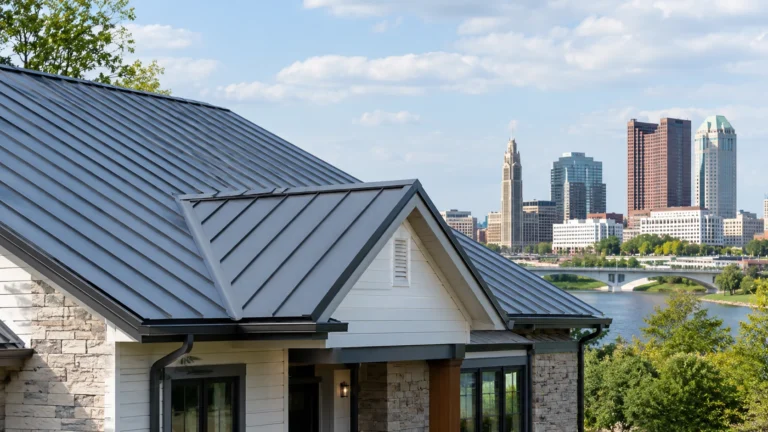
- Standing seam panels — these are the most hail-resistant profile available. Class 4 rated standing seam takes golf ball-sized hail without functional damage. You might see minor cosmetic dimpling on very soft metal colors, but functional performance isn’t affected
In most cases, a quality metal roof rated Class 4 impact will come through a Central Ohio hailstorm without any claim-worthy damage at all. That’s not a sales line — it’s why metal shingle and standing seam systems qualify for insurance discounts in Ohio.
What Hail Damage Looks Like on Gutters, Downspouts, and Vents
These are your best evidence. Aluminum gutters and downspouts dent easily and hold the dent shape permanently. Fresh, circular, evenly distributed dents on gutters that weren’t there before a storm are documented proof that hail fell at that location. Insurance adjusters recognize this and use it as supporting evidence.
Check your:
- Aluminum gutters along every slope
- Downspout bodies — not just the outlets
- Roof vents and pipe boot flashings
- Ridge vent caps
- Any exposed aluminum trim around skylights or chimneys
Photograph all of it before anyone touches anything.
Damage That’s Not Visible From the Ground
This is the category that costs Columbus homeowners the most money — not because the damage is worse, but because they don’t find it until it becomes a water problem inside the house.
Granule loss on asphalt shingles doesn’t immediately mean your roof leaks. It means the UV protection is gone and the mat underneath will degrade faster — sometimes within a season or two in Ohio’s climate. By the time you notice a stain on your ceiling, the insurance window to file a claim may have already closed.
The same applies to impact bruising that cracks the fiberglass mat inside an asphalt shingle without breaking through the surface. Water gets in through the crack during a freeze-thaw cycle, and the damage expands from there. It’s invisible from outside until it isn’t.
This is why getting a professional inspection after any significant hail event — even if the roof looks okay from the ground — is worth the time.
Step 1 — Stay Off the Roof and Stay Safe
We know. You want to go look. Don’t.
Residential roofs are sloped and often wet or debris-covered after a storm. Falls from roofs are one of the leading causes of serious injury for homeowners in Ohio — and that’s before you account for the fact that hail damage sometimes compromises the integrity of the surface you’re walking on. An asphalt shingle that took a direct hit is weaker than it looks.
Beyond the safety issue, there’s a documentation reason to stay off the roof. If you walk around up there and accidentally knock a shingle loose or shift something, it gives an insurance adjuster an opening to dispute whether the damage was pre-existing or storm-related.
Why You Shouldn’t Inspect Your Own Roof After a Storm
You likely don’t know what hail damage looks like versus normal granule loss or UV blistering — and that’s not an insult, it’s just not something most people are trained to identify. Adjusters are. Roofers are. Homeowners generally aren’t, and a DIY inspection that misses something or incorrectly identifies something can create problems with the claim later.
Let a professional document it. That’s what they’re for.
What to Do If You Have Active Leaks Inside the House
If the storm caused an immediate interior leak — water coming through the ceiling, dripping from a light fixture, or pooling on the attic floor — you need to act fast but carefully.
- Place buckets or towels to collect water and protect your floors
- Move furniture and valuables away from the affected area
- Take photos and video of the interior damage — ceiling stains, wet insulation, everything you can document
- Call your insurance company to report an active leak — this typically triggers an emergency response protocol
- Call a roofing company for emergency tarping — a temporary tarp prevents further interior damage while the full claim process plays out
Do not attempt to tarp the roof yourself unless you have professional experience working at height. A second injury on top of a hail claim is not a situation anyone wants to deal with.
Step 2 — Document Everything Before Anyone Touches the Roof
Documentation is the foundation of a successful insurance claim. If you do this part right, everything that comes after is easier. If you skip it or do it halfway, you’re handing the insurance company an easy reason to reduce your payout.
How to Photograph Storm Damage for an Insurance Claim
Use your phone. Modern smartphone cameras are more than adequate. Here’s how to do it properly:
Outside:
- Photograph every slope of the roof from ground level — all four sides if accessible
- Get close-up shots of every section of gutter, especially dented areas
- Photograph the downspout outlets and any granule accumulation
- Photograph your AC unit, any aluminum vents, window screens, and fascia boards
- If you can safely get to a second-floor window that overlooks a lower roof section, photograph that too
Timestamp everything. Your phone already does this automatically in the file metadata, but if you’re sending photos to someone else, make sure the dates are intact. An insurance adjuster will look at photo timestamps.
Video is your friend. A 2-minute walk-around video of your home exterior after the storm — narrated, showing the date and time on your phone — is one of the most useful things you can have when talking to an adjuster.
What to Write Down and When
Keep a simple written log:
- Date and approximate time of the storm
- What you observed during the storm (hail size estimate, duration, wind direction)
- What you found when you walked outside afterward
- Every call you make related to the claim — date, time, who you spoke to, what was said
- Every contractor, adjuster, or inspector who visits your property
This sounds like overkill. It isn’t. Insurance claims can drag on for weeks, and you will not remember the details of a phone call you had in April when you’re still dealing with it in July.
Why Documentation Order Matters for Your Claim
The order of events matters to insurance companies. Here’s the sequence that works in your favor:
- Storm occurs
- You document damage immediately after (photos, video, written notes)
- You call a roofer for an independent inspection
- You call your insurance company to report the claim
- The adjuster comes out with your roofer’s assessment already in hand
If you call the insurance company first, before you have any documentation, you’re starting the process without leverage. The adjuster’s report becomes the baseline. Get your own documentation and your own roofer’s assessment first, then report the claim.
Step 3 — Call Your Homeowner’s Insurance Company
Once you’ve documented the damage and had a roofer do an independent inspection, it’s time to file the claim. Here’s how to handle that first call.
What to Tell Your Insurance Company on the First Call
Keep it factual and brief. You’re reporting damage, not making your case yet. Tell them:
- The date the storm occurred
- That you’ve observed damage to your roof and exterior
- That you’d like to open a claim and schedule an adjuster inspection
- That you already have photos and a contractor’s assessment ready
Ask them:
- What is my deductible for this claim?
- What is the timeline for an adjuster to contact me?
- What is my claim number?
- Who is my primary contact for this claim?
Write all of that down immediately after the call.
What Not to Say to Your Insurance Adjuster
A few things that can complicate your claim:
- Don’t speculate about causes. Say “I observed damage consistent with the hailstorm on [date]” rather than “I think the hail destroyed my roof.” Let the documentation speak.
- Don’t agree to anything on the first call. If an adjuster starts asking whether you’d accept a repair rather than replacement before they’ve even inspected the roof, say you’d like to wait until after the inspection to discuss settlement options.
- Don’t minimize the damage. Some homeowners feel awkward reporting damage. Don’t hedge — report what you found and let the process work.
- Don’t let them rush you. You have time to get your own assessment before the adjuster visit. You’re entitled to it.
How Long Does a Columbus Homeowner Have to File a Hail Damage Claim in Ohio?
Ohio law doesn’t set a single statewide deadline for filing homeowner’s insurance claims, but most policies in Ohio require that you report damage “promptly” or within a specific timeframe — commonly one year from the date of loss, though some policies are shorter.
Here’s the practical reality: the longer you wait, the harder it is to prove the damage is storm-related rather than general wear. Adjusters look at dates. A claim filed three months after a storm for damage that the adjuster thinks could be older than that is a harder claim to win.
File within two to four weeks of the storm, even if you’re still getting inspections done. You can open a claim and continue gathering documentation — you don’t have to have everything finalized before you report.
Does Filing a Roof Claim Raise Your Insurance Premium in Ohio?
Potentially, yes — but not always, and often not as much as homeowners expect. A single weather-related claim (hail, wind) is treated differently by most Ohio insurers than a liability or water damage claim. Many policies don’t raise rates after one weather claim, especially if you have a clean prior history.
What you should do: call your insurance agent before the adjuster visit and ask specifically how a weather-related roof claim would affect your premium under your current policy. Get that answer in writing or at minimum note who told you and when. If the premium impact is significant, you can weigh that against the repair cost — but in most cases, a full roof replacement is worth claiming regardless of the premium effect.
Step 4 — Get a Professional Roof Inspection Before the Adjuster Arrives
This step changes outcomes. Homeowners who have a roofer’s independent assessment before the adjuster visits consistently get better settlements than those who let the adjuster’s report be the only documentation.
Why You Need a Roofer’s Assessment Before the Insurance Adjuster
Insurance adjusters work for the insurance company. They’re not dishonest, but their job is to assess claims accurately — and accurately, in a large insurance company, often means conservatively. An adjuster who spends 20 minutes on your roof and notes “granule loss consistent with age” has just given your insurance company a reason to deny or reduce your claim.
A roofer who spends an hour up there, photographs every impact point, notes the distribution pattern consistent with storm direction, documents the size and depth of bruising on the shingles, and produces a written report — that changes the conversation entirely. The adjuster now has to address a documented professional assessment rather than simply writing their own.
What a Legitimate Hail Damage Inspection Covers
A thorough hail damage inspection should include:
- Assessment of all roof slopes for impact marks, granule displacement, and bruising
- Documentation of gutter and downspout condition
- Inspection of all flashings, vents, and penetrations
- Photographs of representative damage samples across multiple locations
- Notation of hail impact patterns and direction (this helps establish that the damage is storm-related, not wear)
- A written report with findings, estimated repair vs. replacement cost, and material specifications
If a contractor gets on your roof for 10 minutes and hands you a one-page form with checkboxes, that’s not a damage assessment — that’s a sales call. Get a real report.
How to Find a Trustworthy Roofing Contractor in Columbus After a Storm
Every major hail event in Columbus brings out contractors from out of state who drive through neighborhoods, knock on doors, and offer free inspections. Some of them do decent work. Many of them don’t, and a significant number are outright scams.
Here’s how to find a contractor you can trust:
- Look for established local companies with a physical Columbus address — not a PO box or a vague “serving Columbus” designation
- Check for an Ohio contractor’s license — roofing contractors doing residential work in Columbus are required to be licensed
- Look for reviews on Google from verified local customers — not just a high star rating but actual reviews from identifiable Columbus-area homeowners
- Ask specifically how long they’ve been operating in Franklin County
- Ask whether they’ll provide a written damage assessment you can use with your insurance company
A contractor who’s been working in Columbus for several years has the local knowledge to be genuinely useful in the claims process — they know what the adjusters for Ohio’s major carriers typically look for and how to document damage in a way that holds up.
Red Flags to Watch Out For — Storm Chasers in Columbus
After every major hail event in Columbus, out-of-state contractors show up in significant numbers. These “storm chasers” aren’t necessarily doing bad work, but there are patterns to watch for:
- They knock on your door uninvited within 48 hours of a storm — legitimate local contractors don’t need to chase storms because they already have local business
- They offer to waive your deductible — this is insurance fraud in Ohio, full stop. Any contractor who offers to handle your job “for the insurance amount, no deductible required” is committing fraud and putting you at legal risk
- They ask you to sign an Assignment of Benefits (AOB) form — this signs over your insurance rights to the contractor. Don’t sign this without an attorney reviewing it
- They can’t produce an Ohio license number or local business address — legitimate Columbus contractors have both
- They’re gone when something goes wrong — this is the real problem with out-of-state storm chasers. When you have a warranty issue six months later, there’s no one to call
Step 5 — The Insurance Adjuster Visit — What to Expect
Once your claim is filed, the insurance company will schedule an adjuster to inspect your property. Here’s how to handle that visit.
What the Insurance Adjuster Is Looking For
The adjuster’s job is to determine:
- Whether the damage is storm-related or pre-existing wear
- Whether the damage warrants repair or full replacement
- What the replacement cost value (RCV) or actual cash value (ACV) of the damaged material is
They’ll look at the same things a roofer looks for — granule loss patterns, impact marks, damage to gutters and vents — but with a different lens. They’re looking for ways to categorize damage accurately under your policy terms, which sometimes means conservatively.
They’ll also check your policy’s effective date versus the storm date, look at your maintenance history if it’s relevant, and assess whether previous damage was ever repaired or reported.
Should You Be Present During the Adjuster’s Inspection?
Yes. Always.
And if possible, have your roofing contractor present at the same time. A professional roofer who can point out specific damage findings to the adjuster while they’re both on the roof is a significant advantage. It’s much harder for an adjuster to write off granule displacement patterns as “normal wear” when a roofer is standing next to them explaining exactly why it’s consistent with the storm that hit Westerville on April 14th.
Be polite. Be factual. Don’t argue — let your documentation make the case.
What Happens If the Adjuster Underpays or Denies the Claim
This happens. It’s frustrating, but it’s not the end of the road.
Your options:
- Request a re-inspection. You can ask the insurance company to send a different adjuster for a second look. Bring more documentation if you have it.
- File a supplemental claim. If a contractor starts work and finds additional damage that wasn’t in the original settlement, most Ohio policies allow for a supplemental claim. Document everything your contractor finds.
- Invoke the appraisal clause. Most Ohio homeowner’s policies include an appraisal process where both sides hire independent appraisers and a neutral umpire resolves the dispute. This is a formal process but it works.
- Hire a public adjuster. Public adjusters work for you — not the insurance company — and typically take a percentage of the final settlement. In complex or high-value claims, they can be worth it.
- File a complaint with the Ohio Department of Insurance. If you believe your claim was handled in bad faith, the ODI takes complaints and investigates. This sometimes prompts insurers to take a second look.
How Ohio’s Matching Law Protects Columbus Homeowners
This is one of the most valuable protections Ohio homeowners have in a hail claim, and most people don’t know it exists.
Ohio’s matching law requires that when a portion of your roof is damaged and the existing material is no longer available in a matching color, style, or profile, the insurance company must replace the entire visible plane — not just the damaged section.
In practice, this means: if hail damages the south-facing slope of your roof and your existing shingles are discontinued or don’t match available replacement materials, the insurer can’t pay for just the damaged slope. They have to cover the full visible section of the roof.
This is a significant protection. Use it. Your roofing contractor should know how to document matching issues in a way that supports this claim.
Step 6 — Review Your Claim Settlement Carefully
When the insurance company sends your settlement letter, don’t just look at the total number. Read the whole document.
Understanding ACV vs. RCV on Your Ohio Homeowners Policy
This is where a lot of Columbus homeowners get confused — and where they leave money on the table.
Replacement Cost Value (RCV) means the insurance company pays the full cost to replace your roof with materials of like kind and quality, minus your deductible. This is the better coverage.
Actual Cash Value (ACV) means the insurance company pays replacement cost minus depreciation. Your 15-year-old asphalt shingles might be depreciated by 50-60%, which means your settlement check is a fraction of the actual replacement cost.
If you have RCV coverage: the insurance company typically pays in two stages. First, they send an ACV check (the depreciated amount). When you complete the repair and submit the contractor’s invoice, they send a second check for the remaining “recoverable depreciation.” Don’t stop after the first check — file for the second one.
If you have ACV coverage only: your settlement is the final amount. Factor your deductible and the ACV payment into your out-of-pocket calculation.
What a Fair Settlement for Roof Replacement Looks Like in Columbus
Columbus roofing replacement costs vary based on material, pitch, size, and complexity — but rough benchmarks for 2024-2025:
- Asphalt replacement (2,000 sq ft home): $9,000–$16,000 installed with tear-off and permit
- Metal replacement — standing seam or shingles (2,000 sq ft home): $18,000–$30,000 depending on profile and material
- Franklin County building permit: $200–$450 depending on job scope
If your settlement offer for a full replacement comes in significantly below these ranges, it’s worth having a contractor review the scope of work listed in the settlement to make sure nothing was missed or undercounted.
How to Dispute a Low Settlement in Ohio
Start with a written response — not a phone call — requesting a detailed explanation of how the settlement amount was calculated. Ask specifically:
- What depreciation rate was applied and why
- Whether Ohio’s matching law was considered
- What line items cover tear-off, disposal, permit fees, and flashings
Many settlement shortfalls come from line items that were simply omitted from the estimate rather than actively contested. A written request makes the insurance company justify every number.
When to Hire a Public Adjuster in Franklin County
Public adjusters are licensed by the Ohio Department of Insurance and work exclusively on your behalf. They typically charge 10-15% of the final claim settlement.
It makes sense to hire one when:
- Your initial settlement is significantly below actual replacement cost
- The claim is complex (multiple damage types, commercial property, historic structure)
- The insurance company has denied the claim and you believe the denial is wrong
- You don’t have time to manage the back-and-forth yourself
For a straightforward residential hail claim where the main issue is getting a repair approved as a replacement, a good local roofing contractor who knows the claim process can often accomplish the same result without the public adjuster fee.
Step 7 — Choose the Right Roofing Material for Your Replacement
Once the claim is approved, you get to make a decision that most Columbus homeowners wish they’d made the first time: what do you actually put up there now?
Why Most Columbus Homeowners Upgrade to Metal After a Hail Claim
After going through a hail claim — the documentation, the adjuster visit, the weeks of waiting, the deductible out of pocket — most homeowners don’t want to do it again. And with asphalt shingles in Central Ohio, they will do it again. The average asphalt roof in Columbus lasts 15-18 years in our climate. Hail claims happen every few years. The math isn’t in asphalt’s favor.
Metal roofing — standing seam or Class 4 rated metal shingles — is a genuine solution to the cycle. Not because metal is immune to hail, but because Class 4 rated metal is specifically designed to withstand the size of hail that routinely falls in Franklin County without damage that warrants a claim. After installation, many Columbus homeowners see a meaningful reduction in their insurance premium that partially offsets the upgrade cost.
Class 4 Impact-Resistant Roofing — What It Means and Why It Matters in Ohio
The UL 2218 rating system classifies roofing materials by their impact resistance on a Class 1 through Class 4 scale. Class 4 is the highest — it means the material withstood a 2-inch steel ball dropped from 20 feet without cracking. That’s roughly equivalent to golf-ball-sized hail under real storm conditions.
In Ohio, Class 4 rated roofing qualifies for insurance discounts with most major carriers — including State Farm, Nationwide (headquartered right here in Columbus), Erie, and Allstate. The discount varies by policy but commonly ranges from 10-30% off the wind and hail portion of your premium. On a Columbus home, that can translate to $200-$500 per year in savings.
How a Class 4 Roof Can Lower Your Homeowners Insurance Premium
After installation, send your insurance company documentation of your new roof’s Class 4 rating — this typically comes from the manufacturer’s product specification sheet. Request that your policy be updated to reflect the Class 4 credit.
If your agent isn’t familiar with this process, ask specifically for the “impact-resistant roofing discount” or “Class 4 discount.” It’s a real program, not something you have to negotiate — it’s just not always proactively offered.
Metal Roofing vs. Asphalt After Hail Damage — The Long-Term Cost Comparison
Here’s a simplified comparison for a Columbus homeowner replacing a 2,000 square foot roof:
| Asphalt | Metal (Standing Seam / Class 4) | |
|---|---|---|
| Installation cost | $10,000–$16,000 | $18,000–$30,000 |
| Expected lifespan in Columbus | 15–18 years | 50–70 years |
| Replacements over 50 years | 3× | 1× |
| Total replacement cost over 50 yrs | $30,000–$48,000 | $18,000–$30,000 |
| Insurance premium savings | None | $200–$500/yr |
| Insurance premium savings over 50 yrs | $0 | $10,000–$25,000 |
| Hail claim likelihood (Class 4) | Every significant storm | Very rare |
The numbers aren’t close over time. The upfront premium is real, but the long-term math consistently favors metal for homeowners who plan to stay in their Columbus home.
Step 8 — Schedule Your Roof Replacement
Claim approved. Material chosen. Now it’s time to actually get the work done.
How Long Does a Roof Replacement Take in Columbus?
For a standard residential replacement on a Columbus home:
- Asphalt tear-off and replacement: 1-2 days for most homes
- Metal standing seam installation: 3-5 days depending on size and complexity
- Metal shingles: 3-4 days for most residential projects
These timelines assume normal weather. Columbus spring weather is unpredictable — contractors build weather buffers into schedules, and a legitimate company won’t rush a metal installation to beat incoming weather if the conditions aren’t right for proper seaming.
Do You Need a Permit for Roof Replacement in Franklin County?
Yes. Franklin County and the City of Columbus both require a building permit for full roof replacements — not just repairs. Tear-off and full re-roofing trigger the permit requirement.
This matters because:
- An unpermitted roof replacement is technically illegal and can create problems when you sell your home
- If something goes wrong with an unpermitted installation, your homeowner’s insurance may deny a future claim on that work
- A permit creates a public record of the work done — useful documentation for resale
The permit is typically pulled by the contractor, not the homeowner, and the fee runs $200-$450 for most residential projects in Franklin County. Any contractor who suggests skipping the permit to “save money” is not a contractor you want on your roof.
What to Expect on Installation Day
Legitimate contractors handle these logistics — you shouldn’t have to manage the installation day yourself — but here’s what a proper installation sequence looks like:
- Crew arrives early, typically 7-8am
- Materials staged in driveway or nearby — shingles or metal coils, underlayment rolls, tool cases
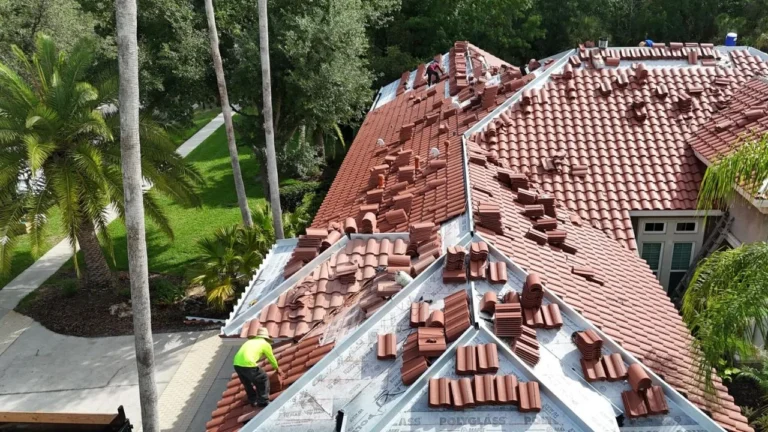
- Tear-off begins (if applicable) — old shingles go directly into a dumpster or debris trailer
- Deck inspection — any rotted or soft decking gets replaced before underlayment goes down
- Underlayment installation — for metal, a high-temp synthetic product specifically rated for metal applications
- Metal panel or shingle installation
- Ridge caps, flashings, and penetration seals
- Cleanup — magnetic sweep for fasteners, gutter clearing, full perimeter check
On a standing seam project, you’ll often see the panels being roll-formed on-site from a truck-mounted machine. This is normal and actually preferred — panels formed to the exact length of your roof slope create cleaner seams than pre-cut stock panels.
How to Protect Your Property During the Replacement
Before the crew arrives:
- Move vehicles out of the driveway if materials need to be staged there
- Cover anything in the garage or on the patio that you don’t want dust on
- Warn your neighbors — a full tear-off is noisy, especially in the morning
- Keep kids and pets inside during the tear-off phase
Your contractor should take care of protecting your landscaping and exterior — drop cloths around foundation plantings, debris chutes or tarps to direct material to the dumpster rather than the yard. Ask specifically what their property protection protocol is before work starts.
Step 9 — Final Inspection and Warranty Documentation
The job is done. Before the crew pulls out of your driveway, there’s one more step that matters as much as any of the others.
What Your Post-Installation Walkthrough Should Cover
Don’t skip the walkthrough. A good contractor will initiate it — if yours doesn’t, ask for it. Walk the full exterior and go through:
- Ridgeline and hips — caps seated correctly, no gaps
- All roof penetrations — pipe boots, vents, chimney flashings sealed properly
- Valley transitions — no exposed edges or unsealed laps
- Gutter condition — cleared of installation debris, downspouts flowing
- Fascia and soffit — no damage from tear-off debris or tool contact
- Lawn and landscaping — magnetic sweep done, no loose fasteners visible
If anything looks off, say so before the contractor leaves. It’s significantly easier to fix something the day of than to schedule a callback six weeks later.
Manufacturer Warranty vs. Workmanship Warranty — Know the Difference
These are two completely separate warranties, and you need both.
Manufacturer’s warranty covers defects in the roofing material itself — panel failures, coating delamination, premature corrosion. For quality metal roofing products, this typically runs 40-50 years. Some premium products carry lifetime warranties. The warranty is with the manufacturer, not your contractor — make sure you receive the official warranty document with your specific product and installation date recorded.
Workmanship warranty covers how the roof was installed — flashing details, seam quality, fastener placement. This warranty is with your contractor. Typical workmanship warranties in the Columbus market run 5-10 years, though some contractors offer longer. A contractor who won’t put a workmanship warranty in writing is telling you something important about their confidence in the installation.
Get both warranties in writing before the crew leaves.
How to Register Your Roof Warranty in Ohio
Many manufacturer warranties require registration to be valid. This is typically done online through the manufacturer’s website within 30-60 days of installation. Your contractor may handle this as part of the job — ask specifically whether registration is their responsibility or yours.
Keep copies of:
- Your warranty registration confirmation
- The manufacturer’s warranty document
- The contractor’s workmanship warranty
- Your permit and permit inspection record from Franklin County
- The full installation invoice
Store these somewhere you’ll actually find them — not just a pile in a kitchen drawer. When you sell your Columbus home, a transferable roof warranty with full documentation is a genuine selling point.
Common Hail Damage Mistakes Columbus Homeowners Make
We’ve helped a lot of Franklin County homeowners through this process. Here are the mistakes we see over and over.
Waiting Too Long to File a Claim
Ohio hail season peaks in spring. By fall, some homeowners are still sitting on damage they haven’t reported because they “weren’t sure if it was bad enough” or “kept meaning to call.” By that point, proving the damage is from the spring storm — and not just general wear — becomes much harder. File promptly. You can always withdraw a claim if the damage turns out to be minor, but you can’t un-close a claim window.
Letting the Insurance Company’s Roofer Do the Inspection
Some insurance companies offer to send their own preferred contractor to assess the damage and do the repairs. This sounds convenient. It isn’t necessarily in your interest. The contractor the insurance company recommends has a financial relationship with the insurance company — their assessment is influenced by that relationship, whether intentionally or not. Get your own independent assessment first.
Accepting the First Settlement Offer Without a Second Opinion
The first settlement offer is rarely the final one. It’s a starting point. If your contractor reviews the scope of work in the settlement and finds items that were missed, undercounted, or undervalued — which happens regularly — a supplemental claim or written dispute can bring the settlement closer to the actual replacement cost.
Hiring an Out-of-State Storm Chaser Instead of a Local Contractor
The door-knocker who showed up two days after the storm with an out-of-state plate and a glossy flyer may do decent work. But if something goes wrong six months after they leave Columbus, there’s often no one to call. Hire a company that has been operating in Franklin County long enough to have a track record, a physical address, and a reason to still be here when you need them.
Patching Instead of Replacing a Storm-Damaged Roof
If an insurer approves replacement and you opt for a patch to pocket the difference, you’re taking on significant risk. A partially replaced asphalt roof has mismatched material ages — the old sections continue to degrade while the new sections perform normally. You lose the ability to document a clean replacement date, which complicates any future claim. And in most cases, the patched sections fail sooner than a clean replacement would have. Use the insurance money for what it’s intended.
Franklin County Roofing Permit — What Columbus Homeowners Need to Know
We mentioned this earlier, but it deserves its own section because permit issues create real problems for homeowners down the road.
When a Permit Is Required for Roof Work in Columbus
In Columbus and Franklin County:
- Full tear-off and re-roofing: Permit required
- Roof-over (installing new material over existing): Permit required
- Structural deck repairs: Permit required
- Minor repairs (replacing a few shingles, fixing flashing): Generally no permit required, but check with the city if the scope of work is unclear
The Columbus Building and Zoning Services Division handles permits for city properties. For properties in suburban Franklin County municipalities — Dublin, Hilliard, Westerville, Reynoldsburg — each municipality has its own building department. Your contractor should know which jurisdiction applies to your property.
How to Check If Your Contractor Pulled a Permit
You can verify permit status online through the City of Columbus’ public permit portal. Search by address and you’ll see any open or closed permits associated with the property. If your contractor says they pulled a permit and you want to verify, this is how you do it.
For suburban Columbus municipalities, most have similar online search tools or will answer a quick phone call from a homeowner checking on permit status for their own property.
What Happens If Work Is Done Without a Permit
The consequences are real:
- The city can issue a stop-work order and require the roof to be re-inspected or torn off
- When you sell your home, the unpermitted work shows up in a title search and becomes a negotiating issue
- Your homeowner’s insurance can deny a future claim related to that work
- You may be required to pull the permit yourself as the homeowner and pay associated fees and penalties
If you discover after the fact that a previous contractor did unpermitted roof work, you can often resolve it by pulling a retroactive permit and having the work inspected. It’s a hassle. It’s better to have it done right the first time.
Frequently Asked Questions — Hail Damage Roof Claims in Columbus, Ohio
How Do I Know If My Roof Has Hail Damage Without Getting on It?
Check your gutters for fresh dents and granule buildup at the downspout outlets. Check your AC unit for dented fins. Look at window screens for small holes or tears. These exterior elements take hits at the same time as the roof — if they’re dented, there’s a very high probability the roof took hits too. Call a roofer for an on-roof assessment before drawing any conclusions.
How Long Do I Have to File a Hail Damage Claim in Ohio?
Most Ohio homeowner’s policies require you to report damage “promptly” — typically interpreted as within one year of the storm. But waiting longer than a few weeks significantly weakens your claim. File within two to four weeks of the storm whenever possible.
Will My Insurance Cover a Full Roof Replacement or Just Repairs?
It depends on the extent of the damage and your policy terms. If hail has damaged more than a certain percentage of your roof — typically 25-30% — most insurers approve full replacement rather than repairs. If you have RCV coverage, they pay full replacement cost minus your deductible. If you have ACV coverage, they pay replacement cost minus depreciation.
What Is Ohio’s Matching Law and How Does It Help Me?
Ohio requires insurers to replace the full visible plane of a roof when damaged sections can’t be matched to undamaged sections in terms of color, profile, or style. In practice, this means a partial hail loss can become a full replacement claim if the existing materials are discontinued or unavailable in a matching version. Your contractor needs to document the matching issue in writing for this to work.
Can I Choose My Own Roofing Contractor for an Insurance Claim?
Yes, always. You have the right to hire any licensed contractor in Ohio for insurance claim work. The insurance company can recommend a preferred contractor but cannot require you to use them. If a preferred contractor and your own estimate differ significantly, you can use the appraisal clause in your policy to resolve the dispute.
How Long Does the Entire Roof Insurance Claim Process Take in Columbus?
From storm to completed installation, typically 4-10 weeks. The variables are how quickly the adjuster is scheduled (this can take 2-4 weeks after filing), how long claim review takes, and how backed up roofing contractors are after a widespread event. After a major hail storm that hits multiple Columbus zip codes at once — like the April 2024 event — local contractors can be booked out 6-8 weeks. File early.
What If My Claim Gets Denied?
First, get the denial in writing and understand exactly why. Common denial reasons:
- Damage classified as normal wear rather than storm damage
- Claim filed outside the policy period
- Pre-existing damage that wasn’t previously reported
Respond in writing requesting a re-inspection. Provide your contractor’s independent assessment. If the denial stands, invoke the appraisal clause or consult with a public adjuster. A flat denial is not necessarily final.
Is Metal Roofing Covered by Homeowners Insurance in Ohio?
Yes. residential metal roofing in Columbus is treated the same as any other roofing material under standard Ohio homeowner’s policies. If hail damages a metal roof, you can file a claim. In most cases, Class 4 rated metal roofing is specifically rewarded by insurers with lower premiums — it’s the most favorable material from an insurance standpoint.
How Much Does a Hail-Damaged Roof Replacement Cost in Columbus?
For a 2,000 square foot home in Columbus:
- Asphalt replacement: $10,000–$16,000 fully installed
- Metal shingles (Class 4): $18,000–$24,000
- Standing seam: $22,000–$30,000
These ranges include tear-off, permit, and disposal. Material and color choice affect cost within each range. Always get at minimum two itemized quotes before accepting a settlement number from your insurer.
Does a New Roof Increase Home Value in Columbus, Ohio?
Yes, and metal roofing increases it more than asphalt. A 2023 Remodeling Magazine Cost vs. Value report found that a new metal roof recoups roughly 60-65% of installation cost in home resale value — comparable to or better than asphalt. More importantly, a new metal roof removes a potential inspection flag that can delay or kill a sale. Columbus buyers — especially in Upper Arlington, Bexley, and Dublin where homes are selling at premium prices — notice roof condition. A 3-year-old metal roof with a 50-year warranty is a selling point. A 15-year-old asphalt with visible granule loss is not.
Get a Free Hail Damage Roof Inspection in Columbus, Ohio
If a recent storm came through your part of Franklin County and you’re not sure whether your roof took damage, the fastest way to get an answer is to call a Columbus metal roofing contractor who knows what to look for and can give you a straight assessment.
We provide free on-site hail damage inspections for Columbus and surrounding communities — including Westerville, Hilliard, Dublin, Pickerington, Reynoldsburg, Bexley, Upper Arlington, Gahanna, and Canal Winchester. We’ll get up on the roof, document what we find, and give you an honest evaluation of whether you have a claim worth filing and what the process looks like from here.
No pressure. No obligation. If the roof is fine, we’ll tell you that too. Call us at (614) 612-9797 to schedule your inspection.